
Engineering a Custom Multi-Lane Depositing System for a Challenging Egg-Based Product
CASE STUDY
Some filling applications expose the limits of standard equipment fast. A food manufacturer producing high-protein wraps was running into that. Their existing line struggled to hold deposit weight and shape across multiple lanes. Operators were pulling off-spec product by hand, packaged units were getting rejected for weight variation, and their previous supplier had told them the equipment was at its limit.
The product itself was the underlying problem. Conventional depositing systems were never designed to handle it. Volumetric Technologies took the project on.
A Difficult Product in a Demanding Production Environment
The product was an aerated food product with a foam-like consistency. It behaved more like a foam or meringue than a typical liquid fill, and that matters. Aerated products compress during transfer and deposit cycles, so small flow variations turn into large weight and shape variations at the nozzle.
The product also was not being deposited into a container. It went directly onto a wide conveyor that fed a downstream press, which formed the finished wrap. That meant the deposit had to be repeatable in both weight and circular shape, fast enough to feed multi-lane production, sanitary enough for food use, and integrated into an existing automated line. Some product varieties also contained seasonings and particulates, which added sealing challenges at shutoff.
The previous supplier had run out of room to improve the equipment.
Starting with Real Product Testing
Rather than start from assumptions, the engineering team brought a single-lane servo filling system and several nozzle configurations onsite to test the customer's actual product. The goal was to see how it behaved under real fill cycles: weight consistency, shutoff, deposit shape.
One core problem showed up almost immediately. As the aerated mixture moved through a standard one-inch transfer hose, it compressed instead of advancing. The hose acted like a spring. Each cycle pushed a little more product in, but after about five feet of hose, no additional product reached the nozzle. That kind of behavior is invisible without application-specific testing, and it ruled out a conventional system design before any drawings were finalized.
The fix was a wider product path. Volumetric Technologies redesigned the system around two-inch piping all the way from the hopper through the filler and out toward the nozzle, restricting only at the final outlet. The wider path kept the product moving without crushing the aerated structure.
Engineering a Multi-Lane Servo-Controlled System
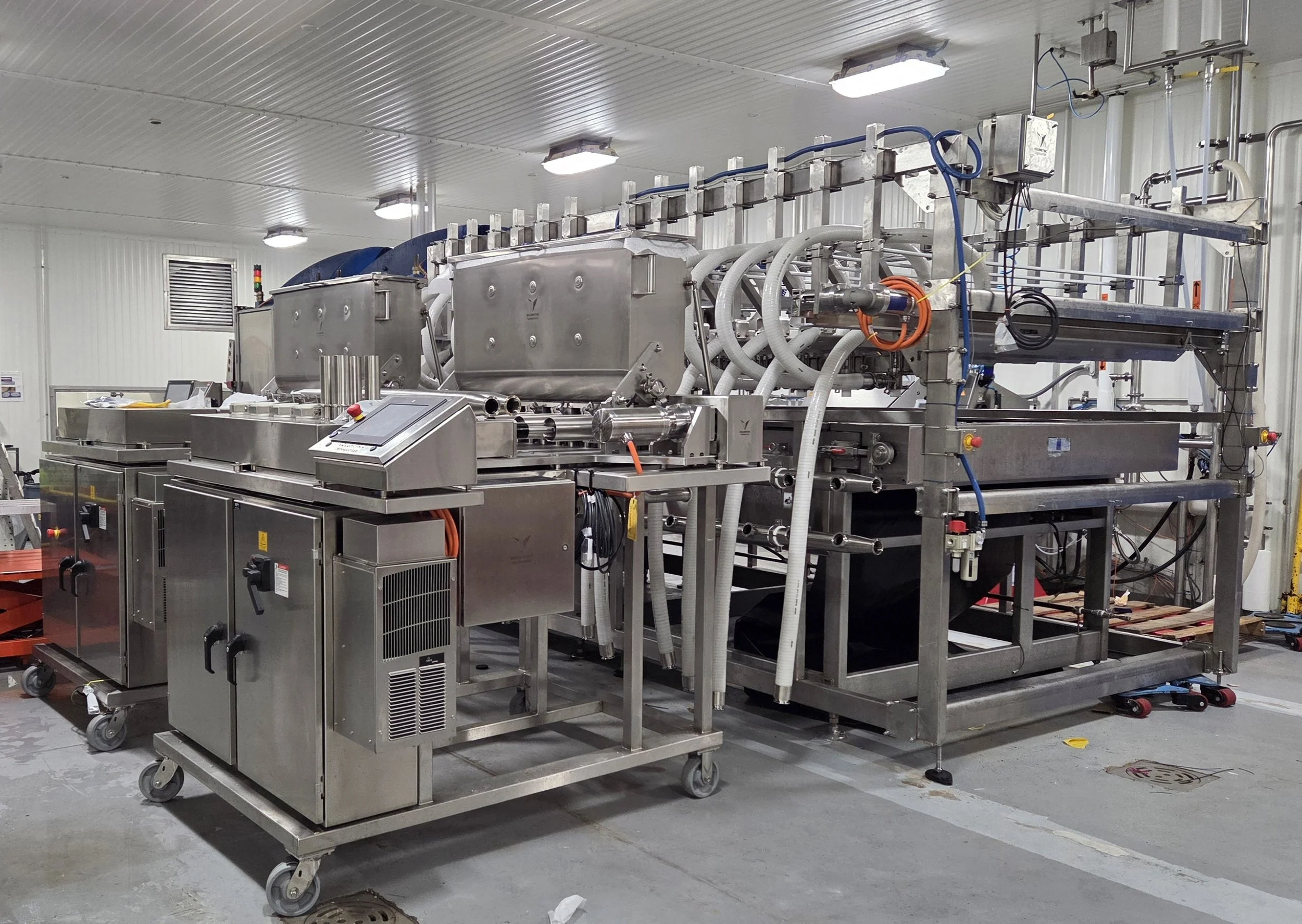
The production system has two 12-lane servo filling systems, 24 lanes total, integrated into the customer's existing line.
Lane-level adjustment was the main limitation of the previous equipment. Traditional pneumatic multi-lane fillers use a single large actuator that drives all pistons together. It is mechanically simpler, but if one lane runs consistently heavy or light because of small differences in piping or piston wear, operators have very little room to compensate without affecting the other lanes.
Volumetric Technologies put an independent servo on every lane. Operators can now adjust a single lane in real time, in fine increments, without touching its neighbors. Weight consistency went up. Manual line intervention went down.
Precision at Production Scale
The contracted spec was strict: a 38 gram deposit held within ±0.75 grams across every lane, with a full array of 72 deposits completed in 18 seconds or less, without losing that tolerance. The system meets and exceeds it.
Each system lays down a full 72-deposit array in 18 seconds of active depositing, then holds about 10 seconds while the belt indexes the finished array forward. Including that pause, each system sustains roughly 144 deposits per minute, putting the full line around 288 per minute. The hardware can run faster, but the operating speed is governed by downstream equipment. Volumetric Technologies tuned the acceleration profiles more gradually than the hardware can handle, which reduces mechanical stress on the servos and extends component life without giving up the required throughput or accuracy.
Holding both the weight tolerance and the cycle time on an aerated product took application testing, custom nozzle work, and independent lane control. The line now runs at spec in normal production, not just under ideal conditions.
Solving Deposit Shape Through Custom Nozzle Engineering
Deposit shape was the other major problem. The previous equipment produced elongated deposits with trailing tails, which created downstream quality issues at the press. The target was a clean, stable circle.
After testing several options, the team built a custom nine-hole capillary dispensing nozzle. Instead of pushing product through one large outlet, the nozzle releases nine smaller streams that merge into a single deposit. The result is a circular shape that holds on every cycle, with a slight ripple at the edge.
Nozzle geometry often makes or breaks an application like this. Engineering the nozzle to the product, rather than fitting the product to a standard nozzle, is what made it work.
Engineering Sanitary Design for CIP Operation
Sanitation was a parallel priority. The customer needed a system that could run clean-in-place with as little disassembly as possible and few places for product to accumulate. The standard approach uses O-ring seals in the nozzle assembly, which require teardown to clean underneath.
Volumetric Technologies replaced that with tri-clamp connections and PTFE cup seals throughout the nozzle assembly. The concept came from sanitary process valves used elsewhere in food production. Adapted for depositing, it lets the customer clean the nozzles in place, which matters more on this line than most because there are 24 nozzles mounted on moving gantries.
The team also worked with the customer's process engineers to integrate spray-ball cleaning into the hoppers, specify washdown-rated components, and design out the small features that tend to harbor bacteria in lower-grade equipment.
Integrating into an Existing Production Line
This was not a standalone install. The depositors had to integrate into existing equipment the customer was already running: conveyors, pressing equipment, the upstream aerators that supply product, and the facility-wide control and monitoring system.
Volumetric Technologies engineered moving nozzle gantries that index across the conveyor in six positions, building a 72-deposit array each cycle that lines up with the downstream press. The system also runs the level control between the aerators and Volumetric Technologies’ hoppers, so the upstream equipment delivers product on demand as the line consumes it.
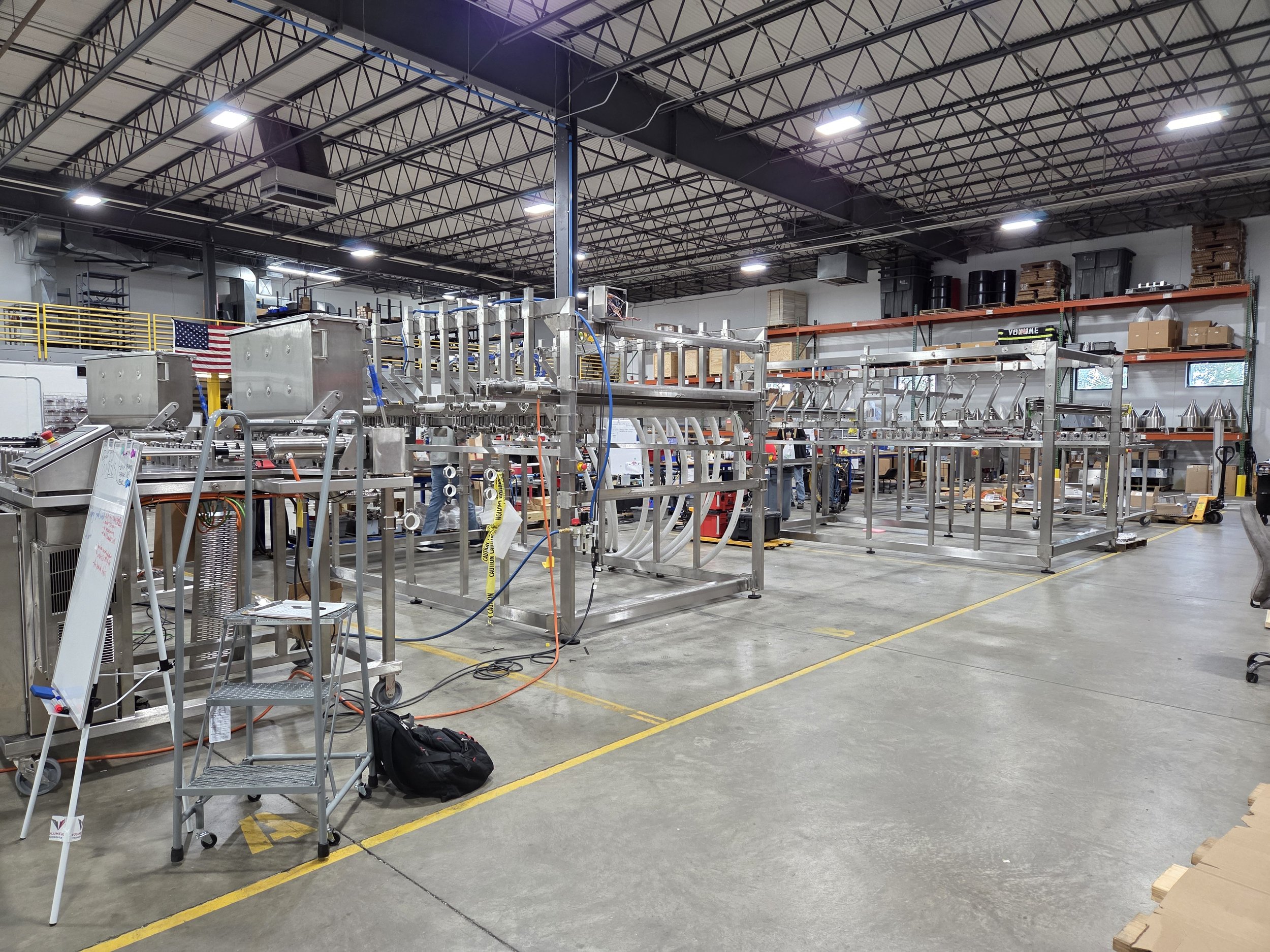
Scale was a logistical issue on its own. The four systems together took up roughly half of Volumetric Technologies’ shop during assembly, and the install required moving major sections of equipment to the customer's second floor. The team coordinated that move with the customer's contractors and pipe fitters on site.
Because the customer's plant runs all of its equipment through Ignition, the depositors' HMI screens sit alongside everything else: aerators upstream, flow wrappers downstream. Operators can monitor or adjust any part of the line from one place.
A Long-Term Engineering Partnership
Custom automation rarely ends at shipment. After install, Volumetric Technologies' engineers were back onsite for startup and tuning, working alongside the customer's team to bring the line up to full production speed. The customer is now running a substantially better process than they were on the previous equipment: better weight control, cleaner deposit geometry, and more lane-level flexibility.
Several of the engineering decisions on this project, including the modular six-lane valve housing and the CIP-capable nozzle design, are now informing other custom depositing work at Volumetric Technologies.
Built for Difficult Applications
Some products do not run on standard equipment. Aerated products, particulates, delicate textures, unusual viscosities, multi-lane production at tight tolerances. These are the applications where an off-the-shelf filler cannot get there, and where engineering the system around the product is the only path that works.
Volumetric Technologies builds filling and depositing systems for that kind of work. Get in touch with our team to see which of our fillers are the right fit.