
Overflow Liquid Filling Machines
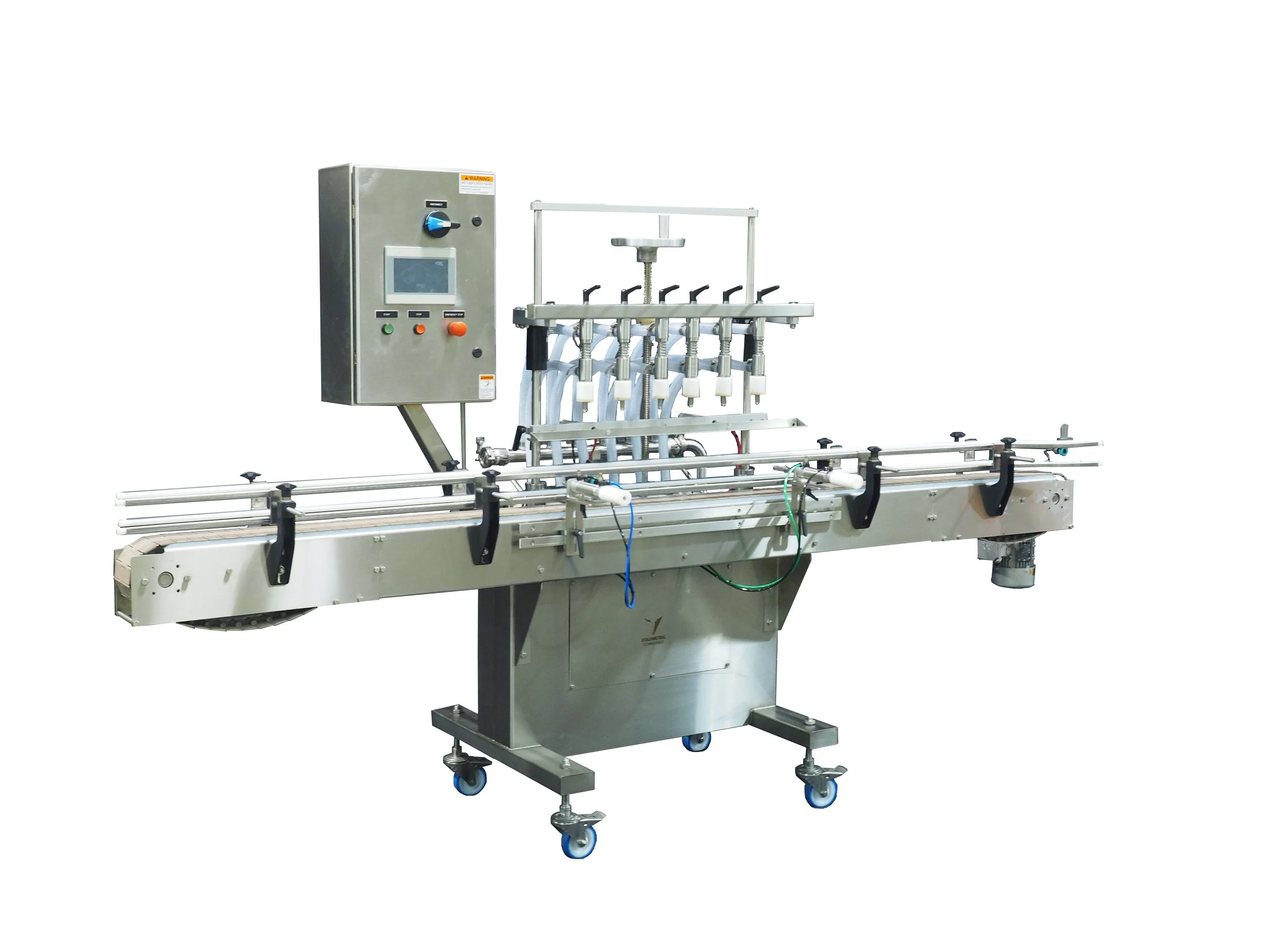
Overflow Pumps are particularly effective for foaming products.
Volumetric Technologies designs and manufactures high-quality overflow filling equipment for manufacturers requiring consistent fill levels and reliable production performance. Effective for foaming or fizzing products, as the excess foam and product are evacuated during the filling process, resulting in clean, consistent fills and improved package presentation.
Engineered for low to medium viscosity liquids, our Overflow Fillers are ideal for products where appearance matters. Precision overflow nozzles ensure glass containers are filled to the same visual level, even when slight variations in container volume exist.
From 2-head to 10-head configurations, Volumetric Technologies Overflow Fillers are built for reliability, quick changeovers, and long-term production performance.
What Sets Us Apart:
• Visually consistent fill levels
• Handles foaming products with ease
• Quick tool-free changeover
• Constructed with 316L stainless steel product contact surfaces
• Built with USDA-approved materials
• Customizable overflow nozzle configurations
• Touchscreen HMI controls
• No bottle / no fill functionality
Product Options:
• Centrifugal or diaphragm pump configurations
• PLC controls and operator interfaces
• 316L stainless steel or PVC nozzle options
• Fill speed controls for foam management
• Straight pipe, barbed fitting, or sanitary clamp nozzle connections
• Pin stop, star wheel, or timing wheel container handling systems
• Container neck locators
• Stainless steel drip trays
• Stainless steel overflow tanks
• Unscrambling tables and accumulation tables
ACCURACY
up to +/- .5 of 1%

FILL VOLUME
1 oz - 5 gallons

SPEED
Up to 30 Cycles
per minute/lane

WASHDOWN
Full washdown (CIP options)
Flexible Pump Filler Solutions for Precision Filling
Our liquid filling pump solutions offer unparalleled flexibility, allowing you to choose from various pump types, such as centrifugal pumps, lobe pumps, and air diaphragm pumps. These pumps seamlessly integrate into our pump filling machines, ensuring consistent and accurate fills every time.

Centrifugal Pumps
Centrifugal pumps are advantageous for moving low-viscosity fluids. They provide efficient and consistent flow rates, making them perfect for high-speed operations.

Diaphragm Pumps
Air diaphragm pumps are perfect for handling sensitive liquids. They offer gentle product handling and are compatible with a wide variety of fluids, making them incredibly versatile to handle a wide range of viscosities and particulate sizes.
Nozzle design matters.
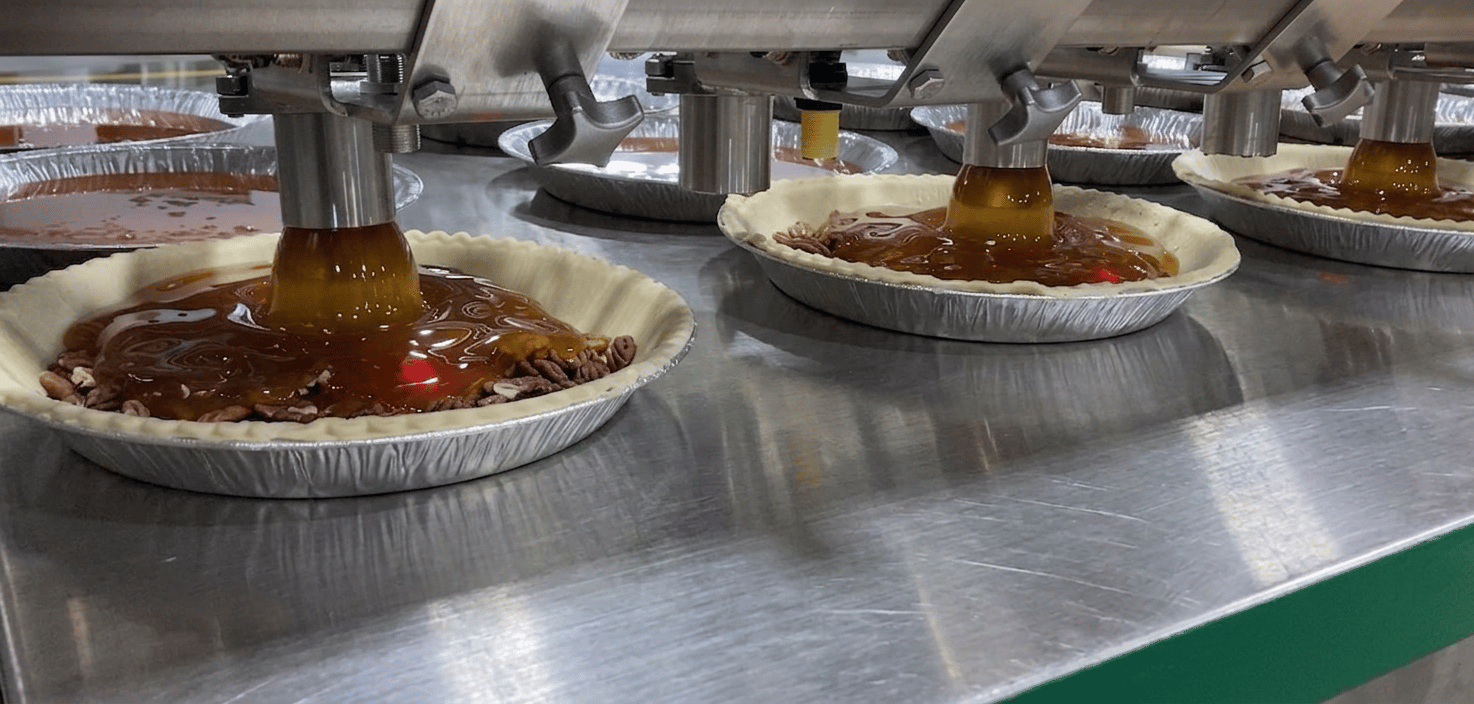
Nozzle design is often the difference between acceptable performance and exceptional performance. Volumetric Technologies has developed hundreds of nozzle configurations to address:
Clean cutoff
Drip prevention
Foaming, Stringy or Delicate products
Products with particulates
Custom deposit shapes
We are experts at nozzle design and execution.
Every product behaves differently.
Product viscosity, particulates, aeration, deposit characteristics, sanitation requirements, and production goals all influence system design. Volumetric Technologies evaluates these factors early in the process to ensure the filling solution is designed around the application—not forced into a standard configuration. We truly partner with you, which includes:
Application Testing & Validation
Custom Nozzle Engineering
USDA-Approved Materials
Designed, Built & Supported in the USA
FAT Video Confirmation
30+ Years of Filling Experience
Fillers for Seamless Operation
Experience the seamless operation of our filling machines, engineered to deliver flawless filling for various container types, precision and user-friendly operation.

User-Friendly Design
With an intuitive touchscreen HMI, these fillers simplify the filling process. The graphics are easy to navigate, allowing operators to quickly access controls and settings.

Quick Changeover Capabilities
Our overflow fillers come with tool-free changeover capabilities, enhancing production efficiency. This feature significantly reduces downtime between product runs, allowing you to adapt swiftly to varying production needs.
Precision Control for Optimal Performance
Accurate fills are crucial in maintaining product quality and customer satisfaction. Our equipment ensures that each fill meets the specified volume, minimizing waste and maximizing profitability.

From Our Blog


-
An overflow filler fills containers to a consistent visual level rather than dispensing a specific measured volume. Product enters the container until it reaches the desired level, while excess product is returned to the supply tank.
This makes overflow filling a strong choice when consistent shelf appearance and repeatable fill height are important.
-
The filling nozzle seals against the container opening and product flows into the container. Once the product reaches the overflow ports in the nozzle, excess product is drawn back into the supply system.
The result is containers that appear filled to the same level, even when there are small variations in the internal volume of the containers.
-
Overflow fillers are typically best suited for thin, free-flowing liquids.
Common applications include water-like products, beverages, cleaners, chemicals, personal care products, and other low-viscosity liquids where a consistent visual fill level is important.
-
Consider an overflow filler when fill level matters as much as—or more than—measuring an exact volume with every cycle.
It's particularly useful with transparent or semi-transparent containers displayed side by side, where inconsistent fill heights can be immediately noticeable to the customer.
-
The biggest difference is what the machine is controlling.
A volumetric filler is designed to dispense a measured volume of product. An overflow filler is designed to achieve a consistent fill level in the container.
If exact volume is your primary requirement, a piston or positive displacement pump filler may be a better choice. If consistent visual appearance is the priority, overflow filling may have an advantage.
-
Containers aren't always internally identical. Small variations in wall thickness, shape, or manufacturing tolerances can cause the same volume of liquid to sit at slightly different heights.
An overflow filler compensates for those differences by filling each container to the same predetermined level.
-
Yes. This is one of their strongest applications.
When customers can see the product through the container, differences in fill height become much more noticeable. Overflow filling creates a clean, consistent presentation across containers on the shelf.
-
Overflow filling can work well with certain products that foam, but the application needs to be evaluated carefully.
Nozzle design, filling speed, product characteristics, and fill level all affect foam control. Volumetric Technologies can configure and test the filling process to determine the best approach for the product.
-
Overflow filling is generally better suited to thin and free-flowing products. As viscosity increases, moving the product through the overflow and return process becomes more challenging and can reduce production speed.
For thicker products, a piston or positive displacement pump filling system may be a better fit.
-
Generally, overflow filling is not the first choice for products containing significant particulates. The product needs to move efficiently through both the filling and return pathways.
For chunky products or products with larger particulates, Volumetric Technologies would typically evaluate other filling technologies.
-
An overflow filler is designed for fill-level consistency, so traditional volumetric accuracy isn't the best way to evaluate its performance.
If your process requires a specific net volume or weight, additional controls or a different filling technology may be appropriate. The application requirements should determine the filling method.
-
Production speed depends on the product, container, desired fill level, number of filling heads, nozzle design, and container-handling system.
Rather than sizing a machine around a theoretical maximum speed, Volumetric Technologies looks at the complete application to determine the number of filling heads and configuration needed to achieve the required production rate reliably.
-
Yes. The desired fill height can be adjusted to accommodate the container and package requirements.
If you're running multiple containers, their neck dimensions, internal geometry, and desired fill levels should all be considered when configuring the machine.
-
Yes, depending on the range of containers.
Container height, neck opening, shape, and fill level can require adjustments or change parts. If you plan to run multiple container formats, Volumetric Technologies can design the system with those changeovers in mind.
-
That depends primarily on the production rate you're trying to achieve and how quickly your particular product and container can complete the overflow filling cycle.
Adding heads can increase throughput, but the filler also needs to stay balanced with your conveyor, container handling, capping, labeling, and other equipment.
-
It can be designed for efficient sanitation and cleaning, but requirements vary considerably by product and industry.
Product-contact components, supply tanks, return pathways, hoses, and nozzles all need to be considered. Volumetric Technologies can configure the system around the sanitation requirements of the application.
-
Yes. Overflow fillers can be integrated with conveyors, container handling, capping, labeling, coding, inspection, and other packaging equipment to create a more automated production line.
-
Start with what matters most about your product and package.
Overflow filling is particularly strong when you have a thin liquid and want a consistent visual fill level. Piston filling is well suited to many viscous products and products with particulates. Positive displacement pump filling provides precise product-flow control and flexibility across many automated filling applications.
Volumetric Technologies offers multiple filling technologies, so the objective is to choose the technology that fits the product rather than forcing the product to fit the machine.
-
Look at more than the number of filling heads or advertised maximum speed. Consider your product characteristics, container variation, desired fill level, sanitation requirements, changeovers, controls, and line integration.
And if appearance is the reason you're considering overflow filling, test with your actual containers. Seeing how your product behaves in its real package can tell you much more than a specification sheet.
-
Volumetric Technologies designs and builds filling equipment in Red Wing, Minnesota, backed by applications, engineering, parts, and service support throughout the life of the equipment.